

Montgomery County, Texas / County
Montgomery County Enterprise & Facility Network Infrastructure
Montgomery County brings together The Woodlands-area corporate environments and Conroe's industrial and distribution activity. Owners considering several facilities need a consistent record system without flattening the difference between an occupied campus and an operating-floor installation.
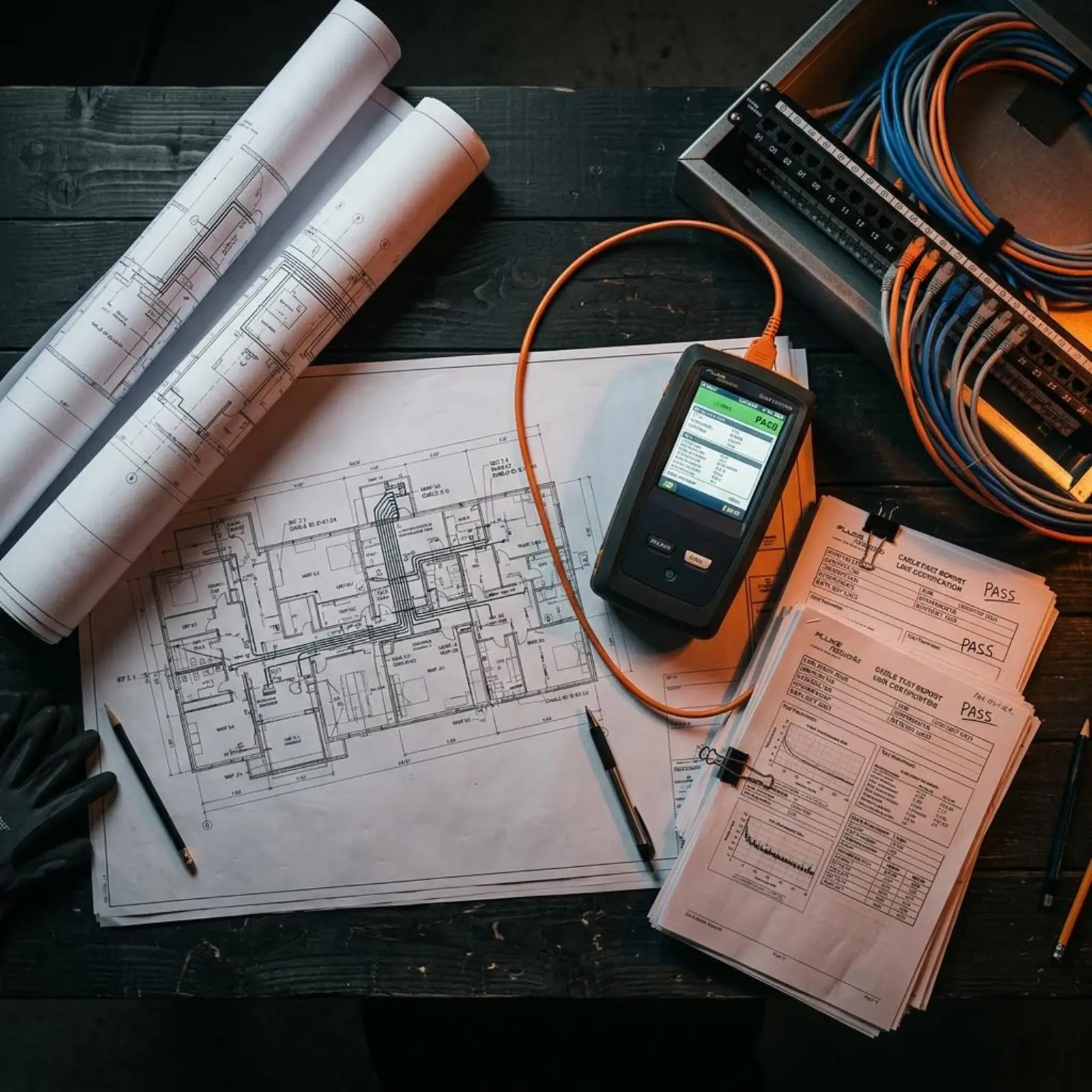
Illustrative image. Not TLVC project work or local photography.
Market context
Build portfolio consistency around verified site differences.
For a Montgomery County program, define a common labeling and test-record format, then record each property's telecom room, backbone routes, and access restrictions separately. A standard is useful when it clarifies local conditions, not when it assumes the same rack capacity, ceiling access, or turnover sequence at every address.
Applications in Montgomery County
Where infrastructure scope shows up.
Discuss fiber distribution and rack documentation across the property group, then coordinate local copper, Wi-Fi and AV endpoints. Shared records should preserve which vendor owns each camera or controlled-door interface.
A-01
Corporate campus changes
Coordinate tenant and property approvals for shared backbone facilities and phased staff moves.
A-02
Industrial park projects
Review entrance routes, operational access, and distance requirements before placing the new facility under an office-derived allowance.
A-03
County-wide facility groups
Use site-specific identifiers so recurring room numbers and panel names remain traceable across separate buildings.
Disciplines
Six disciplines for Montgomery County projects.
Each scope is confirmed against drawings, specifications, and project requirements before pricing.
- SC
Structured Cabling
Copper infrastructure, pathways, racks, patching, labeling, testing, and documentation for commercial environments.
Capability detail - FO
Fiber Optic Infrastructure
Backbone and horizontal fiber infrastructure, terminations, testing, documentation, and project coordination.
Capability detail - VS
CCTV / Video Surveillance Infrastructure
Infrastructure and deployment support for commercial video surveillance systems, subject to project requirements and applicable authorization.
Subject to project requirements and applicable authorization.
Capability detail - AC
Access Control Infrastructure
Infrastructure and deployment support for commercial access control systems, subject to project requirements and applicable authorization.
Subject to project requirements and applicable authorization.
Capability detail - NW
Network & Wi-Fi Infrastructure
Physical network infrastructure, cabling, pathways, equipment-room coordination, and wireless infrastructure support.
Capability detail - AV
Audio Visual Infrastructure
Low-voltage infrastructure and deployment support for commercial AV systems and coordinated technology environments.
Capability detail
Pre-bid review
Planning questions
Questions worth answering before pricing.
- Q01
Which requirements should be common across the property group?
- Q02
How will identical room numbers be distinguished between sites?
- Q03
Does each building have a verified readiness milestone?
Have a Bid or RFP in Montgomery County?
Send plans, deadlines, and scope to our estimating workflow. Available project scope and schedule are reviewed before commitment.
How we work
Four stages. No loose ends.
01
Qualify
Confirm scope, schedule, documents, stakeholders, and pursuit fit.
02
Plan
Review drawings, specifications, risks, alternates, vendor inputs, and project constraints.
03
Execute
Coordinate materials, field work, RFIs, changes, testing, and client communication.
04
Close Out
Deliver test results, documentation, punch completion, and closeout records.
Why TLVC
Enterprise discipline, written down.
01
Clear Scope
Inclusions, exclusions, and assumptions are written down before pricing, not discovered in the field.
02
Controlled Estimating
A defined takeoff and review workflow so every number can be traced back to drawings and specifications.
03
Accountable Ownership
A named point of responsibility for each pursuit and project, from bid day through closeout.
04
Organized Project Records
Submittals, RFIs, changes, and correspondence kept in one structured record set.
05
Proactive Communication
Schedule risks, conflicts, and open questions surfaced early to the people who need them.
06
Documented Closeout
Test results, labeling, as-builts, and punch completion delivered as an organized package.
Related Texas markets
Market research sources
Public sources used for regional context. They are not TLVC project credentials.
Owners, facility teams & partners
Planning a Technology Infrastructure Project in Montgomery County?
CCTV and access control work is subject to project requirements and applicable authorization. Available scope and schedule are reviewed before commitment.